Store Vegetables Without a Root Cellar: Buried Cans, Clamps, and a Cool Garage
A root cellar is a cool, damp room. Most houses in Idaho do not have one. A buried can, a straw-covered clamp, a mulched row, or a bucket of damp sand in a garage that stays just above freezing can hold the same crops, if you give them the temperature and moisture the extension bulletins name.
This is household storage, not a commercial warehouse. The shelf-life numbers below are estimates from those bulletins. University of Minnesota Extension says to expect a shorter life when the spot is warmer than ideal, by as much as 25 percent for every 10°F above the target.
What these crops want
Minnesota Extension sorts long storage into three climates. The one that matters for roots and cabbage is cold and moist: 32 to 40°F and 95 percent relative humidity. Cool and dry (50 to 60°F and 60 percent humidity) is a different room, the kind used for winter squash and pumpkins. Do not put squash in the buried can with the carrots.
Utah State University Extension uses a close match for the moist group, 32 to 40°F and 90 to 95 percent humidity, and lists beets, cabbage, carrots, parsnips, and turnips there. Its table is adapted from USDA Agriculture Handbook 66.
Harvested vegetables are still alive. Minnesota Extension says they breathe and need oxygen, and that a rotting vegetable spreads decay to the others. Put in only sound produce. Washington State University Extension says to discard anything crushed, cut, or already decaying. University of Maine Cooperative Extension says not to wash root vegetables before storage. Wash them when you cook them. UMass Extension says the same: do not wash until you need the root.
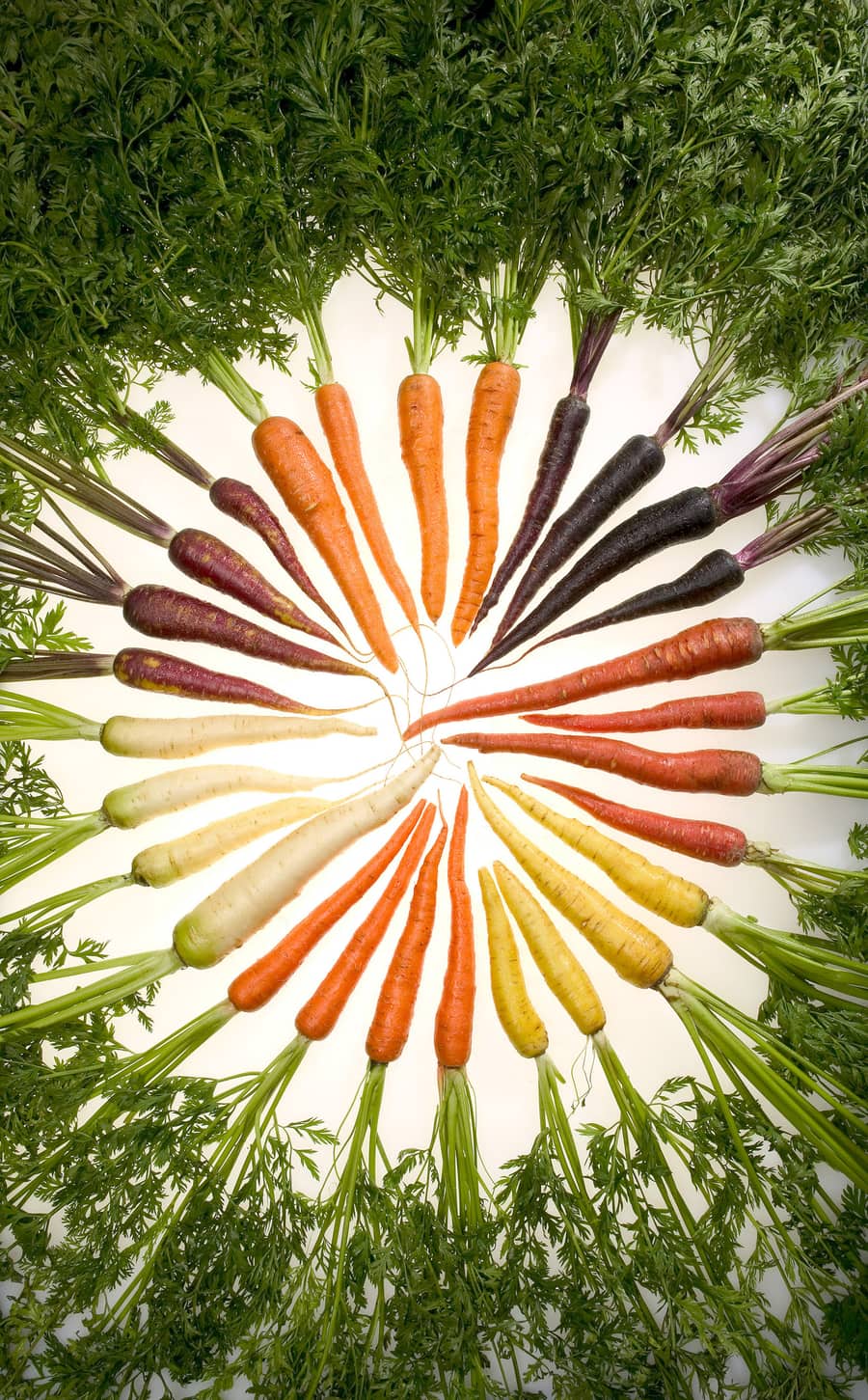
Crops that fit a cold, moist cache
Minnesota Extension’s expected shelf lives are estimates, under cold and moist conditions, with the tops taken off the roots. University of Maine Cooperative Extension is stricter for carrots: 32°F and 98 to 100 percent relative humidity, tops removed, often in a plastic bag so the air stays that wet.
| Crop | Conditions Minnesota names | Expected shelf life |
|---|---|---|
| Carrots | Cold and moist, tops off | 8 months |
| Beets | Cold and moist, tops off | 5 months |
| Cabbage | Cold and moist | 5 months |
| Parsnips | Cold and moist. Do not let them freeze. They sweeten after two weeks at 32°F. | 4 months |
| Turnips | Cold and moist | 4 months |
| Rutabagas | Cold and moist. Minnesota says not to wax them. | 4 months |
Washington State gives cabbage a tighter window in outdoor storage: 32°F, very moist, 3 to 4 months. Pull the plant after the first frost with the root still on, and keep soil around that root. Do not keep cabbage in the basement. The odor moves through the house. Do not store it with celery, endive, apples, or pears. Those pick up the cabbage flavor.
Parsnips are the exception on freezing. Washington State says parsnips, horseradish, and turnips can stand a light freeze and even taste sweeter when held between 28 and 34°F, because starch turns to sugar. The same bulletin says they are hurt by freezing and thawing over and over. Carrots are damaged at about 25°F. Minnesota says not to let parsnips freeze at all. If those two notes disagree, treat a hard freeze as the end of storage and bring the roots in.
Potatoes are colder than the kitchen and warmer than a freeze
Potatoes need darkness. Greening is a reason to reject a tuber, not a cosmetic quirk. Three extensions give the temperature, and they do not use one number:
- Minnesota: dark, cold, and moist, 32 to 40°F and 95 percent relative humidity, after curing 14 days at 50 to 60°F. Expected life six months. Potatoes you will fry should sit at 40 to 50°F so cold sweetening does not darken them in the pan.
- Washington State: cure in the dark at 45 to 60°F for 10 to 14 days, then store at 40°F, very moist, for 4 to 9 months. Colder than that, they say, the flavor goes overly sweet. Sprouts mean the spot is too warm, or that apple gas is in the air.
- Maine: an ideal of 38°F and 95 percent humidity. A cool damp basement is the everyday substitute when that ideal is out of reach.
- Utah State: cure about two weeks at 45 to 60°F, then store in the dark at 40°F. Its summary table also says potatoes stored very cold start to taste sweet, so keep them closer to 40°F.
For a family cache, aim at the 40°F those last three describe, in the dark, and moist. That still sits inside Minnesota’s 32-to-40 band. Check with a thermometer. Guessing from the air in the yard is how a can of potatoes turns sweet or sprouts.
Utah State says to dig the main crop when the vines have died and the ground is dry, and to avoid cuts and bruises. Damaged tubers go to the kitchen now.
What not to store together
Penn State Extension describes ethylene as a gas that ripening fruit gives off. Apples and pears are heavy producers. Carrots and parsnips turn bitter in it. Cabbage and its relatives yellow and go limp.
Washington State is specific about the pairing people get wrong: do not store apples with potatoes or carrots. Ethylene from the apples can sprout the potatoes and turn the carrots bitter. Potatoes make apples taste musty. Cabbage and turnips lend their smell to celery, pears, and apples. Cabbage, kale, rutabagas, turnips, and winter radishes belong in outdoor storage, not in a room that shares air with the kitchen.
Colorado State University Extension, in its Boulder County guide, says the same practical rule: store fruits and vegetables apart. Onions can flavor the neighbors, and gas from apples can bother other produce.
Utah State’s short version: do not store fruits and vegetables together, because fruit releases ethylene and that speeds vegetable ripening.
A buried can is one climate. Fill it with the cold-moist roots, or with cabbage, not with both if you can help it, and never with apples. If you only have one can, pick one crop.
Pick the site before you dig
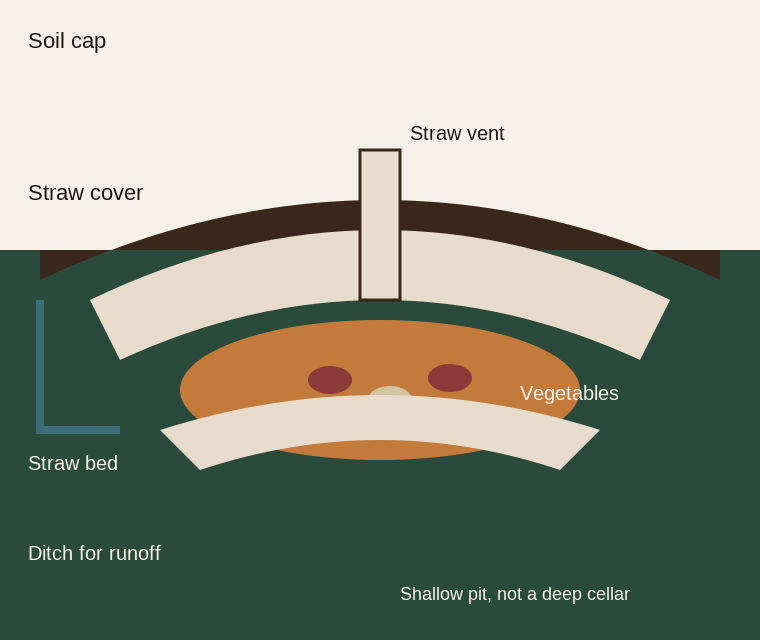
Washington State says outdoor storage is sometimes hard to reach and open to rodents, so drainage and insulation matter more than a clever shape. Choose a spot where water does not stand. A ditch around a mound or a can carries surface water away. Do not dig the cache in a low corner that fills in a February rain.
Idaho does not publish one frost depth for every county. The Idaho manufactured home installation standard says the local building authority sets frost depth, and that permanent footings go at least 24 inches below grade or to the local frost level, whichever that authority requires. Twenty-four inches is a foundation minimum in that standard. It is not a promise that carrots at 24 inches will stay above 25°F. Ask the local building department what frost depth they use, then decide whether a shallow pit plus a thick straw cap is enough, or whether the food should come indoors before the hard cold.
Washington State says roots left in the garden are not hurt until the soil around them drops to about 25°F or below, and that carrots are damaged near that point. A thermometer in the cache tells you more than a rule of thumb. If you cannot read it without a long excavation, the cache is in the wrong place.
Straw, hay, dry leaves, and clean wood shavings are the insulation those bulletins name. Minnesota Extension says the straw or shavings must be clean and not contaminated with pesticides. Do not mulch warm soil. Washington State says mulch on warm ground makes the vegetables decay. Wait until the ground is cold, then cover.
Vegetables need air. A sealed plastic bag sweats and molds. Washington State says to cut ventilation holes in any bag or liner, tie it loosely, and not seal it. On a mound, the same bulletin shows a straw-filled vent so the pile can breathe.
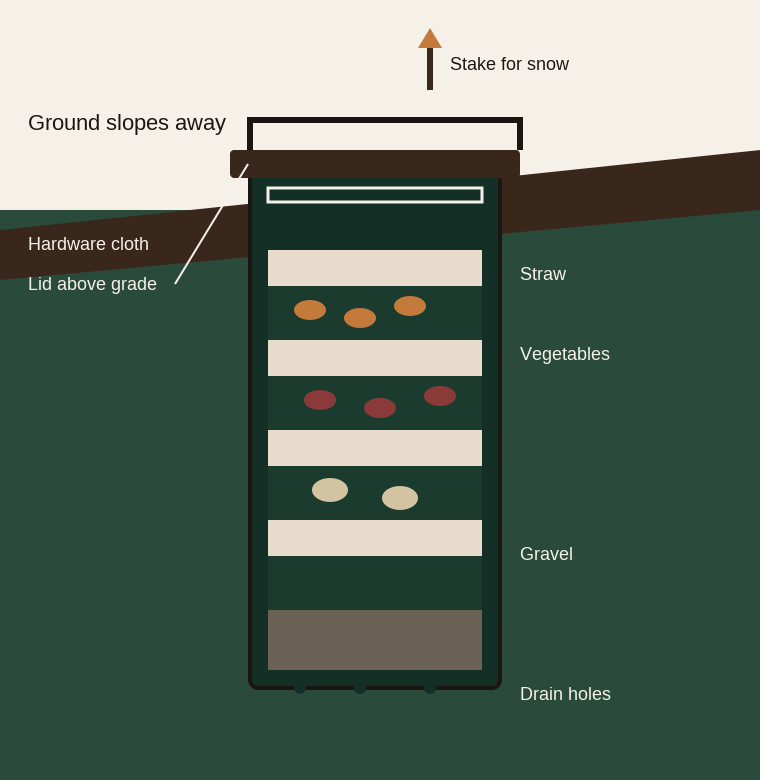
Rodents are the other failure. Washington State notes that one gopher can eat a row of carrots left in the ground, and that young mice can get through a quarter-inch opening. Utah State says that where rodents are a problem, cover the store with quarter-inch hardware cloth. Metal cans resist them better than plastic ones. Hardware cloth under the lid, and a lid that actually seats, matters more than the brand of can.
Mark the spot before the snow. A tall stake at the lid is how you find a can in January. Neither bulletin gives a stake length. Use one you can see over the drifts you actually get.
Buried trash can or barrel
Utah State and Washington State both describe this. Use a can around 20 gallons, short enough that you can reach the bottom. Metal is more rodent-resistant than plastic. Punch several holes in the bottom so water can leave. Never use a drum that held pesticides, fuel, or anything that could flavor food. Washington State says the container has to be free of those residues.
Set the can in a well-drained hole with the lid above the surrounding grade, so meltwater does not pour in. A layer of gravel under the holes gives the water somewhere to go. Pack vegetables in layers with clean straw between them, or in perforated bags. The lid closes. Hardware cloth can sit under the lid. Straw or leaves over the lid add insulation. A ditch or a sloped grade keeps runoff off the rim.
Buried cans are easier to open and close than a mound. Washington State likes them for that reason, and says you can even set one in a shed or breezeway for easier reach and more frost protection. If the can is in or near a garage, wrap the food so it does not sit in vehicle exhaust. Produce picks up those fumes.
Open the can on a dry day, take what you will eat soon, and close it. Washington State says that once a pit or mound is opened, the rest of that batch should come out, and it then keeps a week or two at most. A can with a lid is gentler than a mound, but the same idea holds: do not leave it gaping in the rain, and do not put a soft carrot back in with the sound ones.
Buried cooler or an unplugged chest freezer
Treat a cooler or an old freezer as the same kind of container: food-safe, drained, lidded, and not a chemical drum. Unplug it. Do not run a freezer or a refrigerator in the ground. There is no safe way to power a buried appliance in a wet hole, and you do not need the compressor. The earth and the straw are the cooling.
Drainage is the part people skip. A cooler is built to hold water in. Drill holes in the bottom, set it on gravel, and keep the lid above grade, the way Washington State drains a trash can. A lid that sheds rain is not the same as a gasket that seals the crop into a wet box. Vent it. A closed cooler with no air path will sweat.
The other hazard is a child. The Consumer Product Safety Commission warned that chest freezers made before 1970 often latch from the outside only. Children who climbed in and pulled the lid shut suffocated. CPSC’s test is simple: if you can open the lid by pulling up on the sides, without the handle, it is not that old latch. If it opens only with the handle, do not bury it. Disable the latch or dispose of the freezer. The same caution applies to an old cooler with a clasp a child cannot push open from inside. A storage cache in the yard is still a box with a lid.
Clamp or pit
A clamp is a shallow outdoor pile, not a room you can walk into. Washington State describes a mound or pit for cabbage and for roots such as carrots, beets, celeriac, kohlrabi, rutabagas, turnips, and winter radishes. Dig only 6 to 10 inches down. Deeper protects from frost a little more and also holds more water, which is the tradeoff. Line the bottom with straw or another clean mulch. Pile the vegetables. Separate different roots with mulch so odors do not move between them. Cover with more mulch. A ditch around the edge carries water off. A straw-filled vent lets the pile breathe.
Utah State’s pit is close: excavate 6 to 12 inches, line with straw, add the vegetables, then insulating material, a layer of soil, and a tarp or plastic to shed water. Where rodents live, add quarter-inch hardware cloth. Utah State uses this most often for cabbage, potatoes, and the root crops beets, carrots, and turnips.
Once you open a mound, Washington State says to take the produce out. It will not keep the way an unopened clamp does. Plan on using that opening’s food within a week or two.
Leave the roots in the ground
Washington State says carrots, turnips, and parsnips can stay where they grew for part or all of the winter if rodents are not a problem. After the ground begins to freeze, cover them with a foot or more of straw, hay, or dry leaves. Do not lay that mulch on warm soil. Dig as you need them. Parsnips, horseradish, and turnips can take a light freeze. Carrots cannot take soil near 25°F. Beets, cabbage, kale, leeks, and a few leafy crops can sit under a heavy mulch for several weeks after early light frosts. That is weeks, not the whole winter, for those crops.
Utah State says to cover roots with soil, straw, or leaves until the soil freezes hard, dig what you need, and cover the row again. Bring them inside when temperatures below 28°F are near. Roots that come in from outdoor mulch should be eaten soon. They do not keep like a fresh harvest. If a gopher or a vole is in the bed, Washington State’s advice is to stop using the row and move the crop to a buried can or an indoor box.
In a Mountain West winter the row can disappear under snow. The stake matters here too. Digging frozen ground is hard. That inconvenience is not the same as freeze damage. The damage starts at the temperatures above, not at the first snowfall.
Sand or sawdust in a cool garage
If the yard cache is more work than the crop is worth, use a box indoors. Utah State says to layer dug roots in moist sand, peat moss, or sawdust in a cool, moist place, in bins or crates. Washington State says the same materials, or perforated polyethylene bags, and says storage at 45°F makes roots sprout new tops and turn woody. Keep the box in the coldest, dampest part of the space you have, not next to a furnace.
A garage only works if it stays above freezing and does not fill with exhaust. Washington State says produce stored in or near a garage has to be wrapped so it does not pick up vehicle fumes. An attached garage that swings from 20°F to 60°F is a poor root cellar. Put a thermometer in the box. If it spends nights below freezing, move the box.
Onions and garlic do not belong in that damp sand. They want a cold, dry place after curing. That is a different shelf. This note is about the moist roots.
Check for rot
Open the store every couple of weeks, on a day when you are not pouring heat and rain into it. Minnesota Extension says rotting produce spreads to the rest. University of Maine says to check often and throw out anything soft or rotten. One bad beet in a layer of sand is how you lose the layer.
Smell the can before you reach in. A sour or musty smell means something has already gone. Do not wash the good roots and put them back wet. Washington State says water sitting on the surface feeds mold. Keep the packing moist, not dripping.
Sprouts on potatoes mean the temperature is high or apples are nearby. Green skin means light. Bitter carrots can mean ethylene. None of those get safer by cutting off the bad spot and burying the rest for another month. Use the sound ones soon, or discard the batch.
A short setup list
- Choose sound roots and firm cabbage. Leave blemished food in the kitchen.
- Cut tops. Do not wash. Brush off dry soil.
- Cure potatoes in the dark for about two weeks before they go into the cold.
- Pick a drained spot, or a garage corner you have measured with a thermometer.
- Ask the local building department for the frost depth they use. Do not invent one.
- Bury a clean, drained metal can with the lid above grade, or build a 6-to-12-inch pit with straw, soil, and a vent.
- Add quarter-inch hardware cloth where rodents live. Prefer a metal can.
- Keep apples, onions, and the moist roots apart.
- Stake the lid before snow.
- Look for rot on a schedule, and throw out anything soft.
The root cellar page is where this site keeps cool-storage notes. Canning and drying are separate, and they follow tested methods when those guides are written. A winter’s carrots in a can are not a substitute for the water and shelf-stable food in the 72-hour kit.
Sources
- University of Minnesota Extension, “Harvesting and storing home garden vegetables,” Cindy Tong. Cold-and-moist conditions, shelf-life estimates, and the warning that rot spreads.
- Utah State University Extension, “Harvest and Storage of Vegetables and Fruits.” Buried cans, pits, hardware cloth, in-ground mulch, sand and sawdust, potato curing, and the storage table adapted from USDA Agriculture Handbook 66 (Gross, Wang, and Saltveit, 2014).
- Washington State University Extension, “Storing Vegetables and Fruits at Home,” Sue Butkus, EB1326. Pits, buried cans, mulch depth, 25°F carrot damage, ethylene, and cabbage.
- University of Maine Cooperative Extension, Bulletin #2077, potato storage, and the note on storing carrots at 32°F and 98 to 100 percent relative humidity. Also the food-safety note in Eat Well, fall/winter 2019–2020.
- Penn State University, “Your Produce May Be Getting Gassed in the Refrigerator.”
- Colorado State University Extension, Boulder County rural living guide, storage section.
- UMass Extension, “Root Crops.” Tops cut a half inch above the crown, and do not wash until use. That half-inch cut also appears in the Washington State bulletin.
- Idaho Division of Occupational and Professional Licenses, Manufactured Home Installation Standard (January 2018), on locally set frost depth.
- U.S. Consumer Product Safety Commission, chest-freezer latch initiative.
- USDA Agriculture Handbook 66, as cited by Utah State University Extension for the temperature and humidity groups.
Comments
Comments open soon. Nothing you type here is saved.