What do I do if communications go down?
The other note, what if the internet goes down, is about cash, paper records, a full tank, and the food already in the house. This one is about finding each other. Write the plan on a quiet evening. You will not invent it in a parking lot.
Ready.gov’s Family Emergency Communication Plan (July 2015) starts with three steps: collect the numbers on paper, share a copy with every person, and practice. Phones and computers can fail, and so can the power that charges them. The plan is how you still meet.
One person outside the area
Pick one person who lives outside your town, and outside the storm if you can. Ready.gov says a long-distance call can be easier than a call across town, because local lines jam first. Everyone texts or calls that person with one sentence: where you are, and whether you are going to a meeting place. That person does not have to drive anywhere. Their job is to tell the next family member the same sentence.
Write the name and the number on paper. Ready.gov also says to store one emergency contact in each phone under “In Case of Emergency” or “ICE,” and to be sure the out-of-town person knows how to text. A contact that lives only in an app is gone when the phone is dead.
Three places, plus a room inside
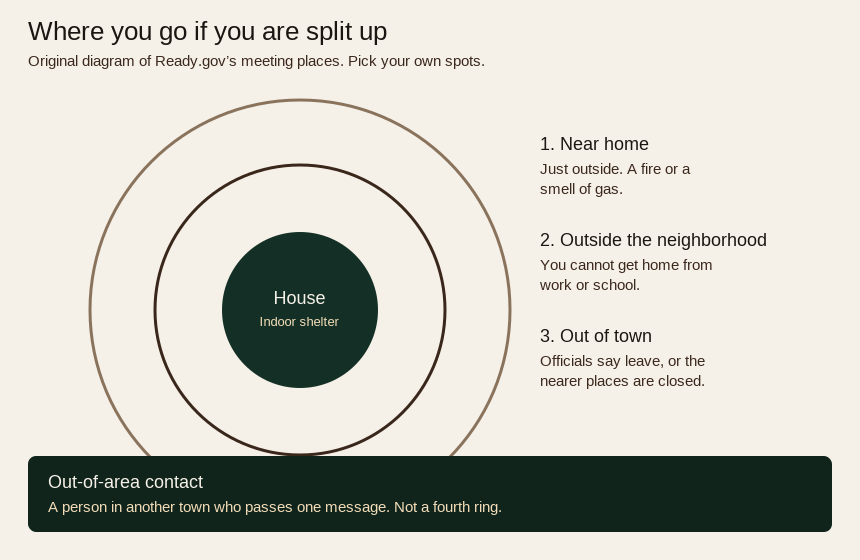
Ready.gov asks for four kinds of places, and it asks that they be familiar and that people with disabilities can actually use them. Pets need a place that will take the animal. The four are:
- Indoor. A small interior room without windows, on the lowest floor, for wind. A closet or a bathroom. This is where you stay when the danger is the weather outside, not the house itself.
- In the neighborhood. Where you meet if you have to leave the house, such as a fire. Ready.gov’s own examples are a large tree, the mailbox at the end of the driveway, or a neighbor’s house.
- Outside the neighborhood. Where you meet if you are at work or school and cannot get home. A library, a community center, a house of worship, or a friend’s house.
- Outside your town. Where you go if officials tell the community to leave, or if you cannot reach the nearer places. A relative’s house. Everyone needs the street address, and a way to get there that is not “we will look it up.”
Worked example. This household is made up. It is here so the blanks have a shape. Do not copy the places. Copy the questions.
A family of four lives on a block in a small Mountain West town. Their indoor spot is the hall closet on the lowest floor. Their near-home spot is the mailbox at the end of their own driveway, which they can see from the sidewalk. Their outside-the-neighborhood spot is the county library, because it is open on weekdays, it is not the school, and a child can name it. Their out-of-town spot is a grandparent’s house two counties away. The address is on the card. The out-of-area contact is a different relative, in another state, who stays by a phone and does not travel. If the house smells like gas or is on fire, they go to the mailbox and text that relative once. If a parent cannot get home from work, that parent goes to the library, not to the mailbox, and sends the same one-line text. If the county says leave, they go to the grandparent’s address and text once from the road if the phone still sends.
What each person carries
Ready.gov says every person carries a paper copy, in a backpack, a purse, or a wallet, and that a copy is posted at home, on the refrigerator or the family bulletin board. The card is small on purpose.
- Names of the people in the household.
- The out-of-area contact, with a phone number.
- The indoor room, the near-home spot, the outside-the-neighborhood spot, and the out-of-town address.
- The school or workplace reunification site, once you have asked for it.
- Any radio channel you have actually practiced.
- Allergies or a medicine a stranger would need to know. The Red Cross kit list already asks for a medication list on paper.
A child who cannot read yet can still learn two sentences: the near-home spot, and the out-of-area person’s first name. Practice on an ordinary week, which is Ready.gov’s third step. A card in a drawer is not a plan.
School and work
Ask this year, not the day of the fire drill. The CDC’s page for parents says every school and childcare should have a written plan for how you will be contacted and where the children will go. Update the school’s emergency contacts when a number changes. Put a card in the child’s backpack.
The same CDC page says that if the school evacuates the children, do not go to them during the emergency. Going there can put you and the children in more danger. Wait until the emergency is over or the school says it is safe to pick up. Bring a photo ID when you do. The school will not release a child to a neighbor who is not on the card. Ask who is allowed to pick up, and write those names down. Do not call the school switchboard in a loop. The lines are for the people running the evacuation.
Work is the same idea without a CDC page that names your employer. If you cannot get home, go to the outside-the-neighborhood place you already chose, and send one text to the out-of-area contact. Do not drive toward the school unless the school has named a reunification site and told you to go there.
When to wait, and when to move
Wait when someone in charge has told you to stay. That includes a shelter-in-place order and a school that has not released students. The FCC’s emergency page, reviewed 1 May 2026, says to limit non-emergency calls, keep any call short, and wait 10 seconds before you redial a call that did not connect. Hammering the button makes the jam worse.
Move when the building you are in is the danger, or when officials say leave.
- Fire, smoke, or a gas smell: leave the house and go to the near-home spot. Do not go back in for the radio.
- You are at work or school and the roads home are closed: go to the outside-the-neighborhood place. Do not cruise the neighborhood hoping to see someone.
- Officials say the town should leave: go to the out-of-town address on the card. Take the go-bag if it is already by the door. The supply list for that bag is the 72-hour kit guide.
- You are lost on a trail, not in a family reunion: the National Park Service says stay put if you cannot find the trail, and signal from there. Moving makes you harder to find.
One text, then stop refreshing. If it does not send, go to the place you agreed. The place is the backup for the text.
Batteries, a charger, and a paper map
The FCC’s July 2025 note says to keep phones, power banks, and chargers charged before a storm, and it treats that as the same kind of job as food and water. A power bank that is empty in a drawer is a brick. Ready.gov’s kit page asks for extra batteries for the radio and the flashlight.
A paper map of the meeting places does not need a tower. Mark the library, the out-of-town address, and the school reunification site with a pen. How maps, cash, and fuel fit a longer outage is the internet-outage note. This page does not repeat that shopping list.
Tools, with the limits attached
The FCC suggests a PACE stack: a primary method, an alternate, a contingency, and an emergency method. For this household the stack is a text, the out-of-area person, a radio you have practiced, and the meeting place if none of those works. None of the radios below replaces 911.
Text messages. The FCC’s tips for communicating in an emergency say that in many cases a text will go through when a call will not, and that a text also leaves more room on the network. Ready.gov’s family plan gives the same reason: a text uses less of the network, and it may wait and send when there is capacity. The FCC emergency page adds that delivery can be delayed while the network is crowded. Pros: short, quiet, and more likely than a voice call. Cons: a dead tower holds the message. Text-to-911 exists only in some places. The FCC says to check before you rely on it, and to call 911 for a life-threatening emergency when a call will connect.
A NOAA weather radio. Ready.gov’s kit page asks for a battery or hand-crank radio, and a NOAA Weather Radio with tone alert. NOAA Weather Radio is how the National Weather Service sends watches and warnings. Pros: it talks when the phone does not, and it does not need a cell plan. Cons: it is one direction. You cannot answer it, and it will not tell your sister you are at the library. The buying notes are the communication guide.
FRS walkie-talkies. The FCC’s consumer guide says the Family Radio Service is for short distances, generally less than half a mile on the half-watt channels and up to about two miles on the two-watt channels, depending on conditions. FRS is licensed by rule, which means you do not apply for a license if you follow the rules. Any age can use one. Pros: no fee, no test, and a child can carry one after you have practiced. Cons: the range is short, the channels are shared, and buildings and canyons shrink the FCC’s “about two miles.” Older radios labeled for both FRS and GMRS may legally use only the FRS channels unless someone holds a GMRS license. The walkie-talkie list compares five radios from published specs. This site did not field-test them.
GMRS. The FCC’s GMRS page says you need a license, issued for ten years. You apply if you are 18 or older and not a representative of a foreign government. After you have the license, any family member, at any age, may use the radios in that system. The FCC’s personal-service fee guide, effective 23 May 2025, lists a $35 application fee for a new GMRS license and shows no regulatory fee on that line. Renewal on the same guide is also $35. Fees change. Read that page, or fcc.gov, before you pay. Pros: one license covers the household, and the service allows higher power than FRS, including repeaters where the rules and the radio allow them. Cons: you may not transmit until the license is granted, the fee is real money, and a ridge will still block a handheld. The mile number on the box is advertising until you try the radios on your own street.
Ham radio. Amateur radio is a different service. The FCC says you need a license grant, and you get it by passing an exam given by volunteer examiners. Most people start at Technician, which is one written element. The exam page says that element is 35 questions and the passing score is 26. The same fee guide lists $35 for a new amateur license application. Volunteer examiners may also charge their own out-of-pocket reimbursement. That second fee is theirs, not the $35. Pros: with practice and a repeater, FEMA’s CERT communications unit describes amateur radio as able to reach beyond 100 miles. Cons: the license belongs to the person who passed, not to the whole family. The radios take study. A ham radio in a closet does not find your child at the library.
Satellite messengers, and satellite SOS on a phone. A dedicated messenger sends a short note or an SOS through a satellite when there is no cell tower. You need a clear view of the sky, and you usually need a plan you pay for before the trip. Pros: it can work where the towers are gone. Cons: it is slow, it is not a phone call, and a canyon or a deep porch can block the sky. Do not buy one on the promise of a range printed in an ad. Read the company’s own coverage page.
Some phones can text emergency services by satellite when there is no cellular and no Wi-Fi. Apple says Emergency SOS via satellite is on iPhone 14 and later, needs you to be outside with a clear view of the sky and the horizon, and is free for two years after that iPhone is activated. It is for emergency services, and it can notify emergency contacts you set up ahead of time. Google says Satellite SOS is on Pixel 9, Pixel 9 Pro, Pixel 9 Pro XL, and Pixel 9 Pro Fold, in the United States except Hawaii and Alaska. You dial emergency services first. If the call cannot connect, the phone offers the satellite path, and you stay outside to receive a reply. Pros: no extra radio, if you already own one of those phones. Cons: it is not on every phone, it does not replace a family text, and a roof blocks it. Set the emergency contacts before you need the feature.
A whistle and a mirror. These are for being lost or trapped, not for calling someone to dinner. Ready.gov’s earthquake page says if you are trapped, send a text or bang on a pipe or a wall, cover your mouth, and use a whistle instead of shouting. The National Park Service outdoor emergency plan says to blow the whistle three times, pause, and blow three times again, because yelling spends energy you need. The same plan says a mirror can flash at aircraft and does not use a battery. Yosemite’s wilderness page says if you are lost and cannot find the trail, stay put, and that any signal done three times in a series is a universal distress signal. Pros: they work with no network and almost no power. Cons: they reach people who are already looking, or who are close enough to hear. They do not tell your out-of-area contact where you are.
A board, and Safe and Well. Ready.gov’s home copy of the plan goes on the refrigerator or the family bulletin board, where someone in the house can read it without a phone. A neighborhood bulletin board is only useful if your town actually checks one. Ask the library or the fire station. Do not assume a cork board downtown is monitored.
The American Red Cross Safe and Well list is the organized version of “tell them I am okay.” You register yourself. Relatives search. The FCC and FEMA noted it in 2011 as one way to post that you are okay without a voice call. It needs a working internet connection. It is not a substitute for the out-of-area phone number, and it does not help if nobody outside the outage thinks to look.
A plan you can print
Fill the blanks in pen. The boxes are for the kitchen table. Nothing you type here is saved. Print from the browser. The site header and footer drop off the printed page.
Family communication card
Sources
- Ready.gov, Family Emergency Communication Plan, July 2015, and Make a Plan for kids.
- Ready.gov, build a kit, and earthquakes.
- CDC, before, during, and after an emergency, for parents.
- FCC, tips for communicating in an emergency, and fcc.gov/emergency, reviewed 1 May 2026.
- FCC, five ways to be communication-ready, 1 July 2025.
- FCC, personal radio services, FRS, and GMRS.
- FCC, personal service and amateur application fees, effective 23 May 2025. Check this page before you pay.
- FCC, amateur radio service and examinations.
- FEMA CERT, emergency communications unit.
- National Weather Service, NOAA Weather Radio.
- Apple, Emergency SOS via satellite.
- Google, Satellite SOS on Pixel phones.
- National Park Service, outdoor emergency plan, and Yosemite wilderness safety.
- American Red Cross, Safe and Well, and survival kit supplies.
- FCC and FEMA, how to communicate in a major disaster, 21 September 2011.
Videos
Press play to load a video. Nothing from YouTube is requested until then.
Comments
Comments open soon. Nothing you type here is saved.