What if the internet goes down?
A multi-day internet outage is a shopping problem and a “where is everybody” problem. The card reader at the store, the ATM, and the app on the phone can fail together, while the food already in the house does not. This note is for a household that wants to get through that stretch without inventing a new way of life.
None of the public pages below name a dollar amount to keep in a drawer. Where this page picks a way to do the arithmetic, it says so.
Why the card and the ATM fail
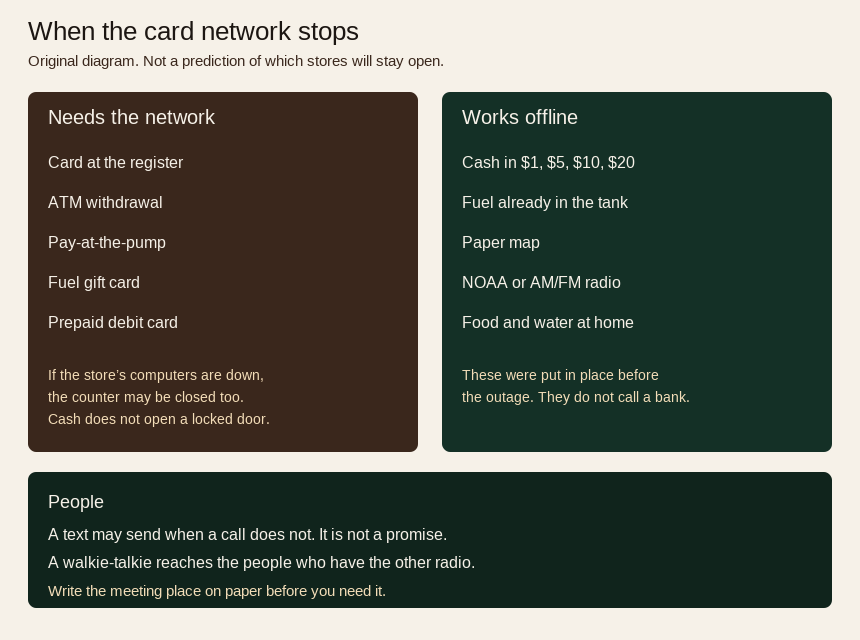
A card payment is a short conversation between the register, a payment network, and a bank. An ATM is another conversation with the bank. If the computers in the middle are down, the plastic in your wallet does not spend, and the machine on the sidewalk does not hand you bills. The internet on your phone can be fine while the store’s system is not, or the other way around.
On 19 July 2024, CrowdStrike said a defect in a Falcon content update for Windows hosts caused a global outage. The company said Mac and Linux hosts were not affected, and that it was not a cyberattack. CrowdStrike’s note to customers is the company’s own account. The Associated Press described grounded flights, banks, and hospitals among the services hit that Friday.
The payment examples from that day are uneven, which is the point:
- WJRT in Mid-Michigan reported that Speedway stations could not take credit cards. Some locations closed. Others stayed open for cash only. The station attributed it to the CrowdStrike update. (WJRT, 19 July 2024)
- The Associated Press reported that customers of at least two large South African banks could not pay with bank cards at grocery stores and gas stations, or use ATMs, and that those banks said service was restored within hours. The same report said Brazil’s Bradesco told clients its digital services were unstable while its ATMs were working, and that the German grocer Tegut closed its 340 stores in the morning because the registers were down, with more than half open again by early afternoon. (AP report, as carried by NEWS10)
- American Airlines said a widespread vendor issue stopped its operation and that it had safely restarted by 5 a.m. Eastern on 19 July 2024, with delays and cancellations still expected that day. (American Airlines newsroom)
A card outage can last hours, or it can close the only station on your road for the morning. You will not know which until you are standing there. Cash you already have is the part you control.
How much cash
Four public pages describe the job. None of them prints a dollar figure.
- Ready.gov’s financial preparedness page, updated 13 March 2026, says to keep a small amount of cash at home in a safe place, in small bills, because ATMs and credit cards may not work when you need supplies, fuel, or food. The same page says to keep savings in an emergency account.
- FEMA’s Are You Ready? guide (publication P-2064, September 2020) says to keep enough cash to buy food, fuel, and a few nights in a hotel if you have to evacuate. It also says banks may be closed and cards and ATMs may be unavailable.
- FEMA’s Emergency Financial First Aid Kit (EFFAK, publication P-1075, September 2019, written with Operation HOPE) says to keep some cash with your papers for when ATMs are down or banks are closed. The amount should follow your family’s basic needs, including food, gas, and the other things you buy day to day.
- The FDIC’s disaster page for consumers says that for a while you may only be able to pay for everyday purchases with cash. Keep some where you can reach it if you leave. Do not keep more at home than you need for immediate needs after a disaster. An August 2025 FDIC Consumer News article says the same thing in shorter form: a small amount for food or supplies if ATMs and credit cards are not working, and larger amounts belong in an FDIC-insured bank. The FDIC page points to the Consumer Financial Protection Bureau for rebuilding finances after a disaster. Those CFPB pages are about recovery, not a cash-at-home quota.
Opinion, not an agency rule. Use your own spending, not a national average. Add three lines from last month: the groceries you would have to buy if the pantry were empty, the fuel you would still need to buy, and pharmacy copays you might have to pay in person. Skip rent and the electric bill if those leave your account without a cashier. Divide the sum by 30. That is one day of cash purchases. Multiply by 3 for a long weekend of closed card readers. Multiply by 7 for a week of buying from people who can only take bills.
The two-week food and water below is stored at home, so it is not all purchased with this cash. Hotel nights are a separate pile, and only if leaving is the plan. FEMA’s guide names “a few nights.” It does not name a room rate. Write the rate of a place that would actually take your household.
Here is the arithmetic with a round number chosen so the division is obvious. The $300 is not an average and not a recommendation. Replace it with your total.
| Your lines | Illustration only |
|---|---|
| Groceries, fuel you still must buy, and pharmacy copays | $300 in a month |
| Divide by 30 | $10 a day |
| Times 3 | $30 for a long weekend |
| Times 7 | $70 for a week of cash purchases |
A household that spends more writes a larger first number. A household that already has the food writes a smaller one. Four people do not multiply the answer again if those three lines already include everyone.
One more opinion: do not keep the whole amount in one envelope. Most of it can sit with the papers. A smaller share can sit in the bag you would take if you leave, and a little in the car. The FDIC’s point is that you can reach it on the way out, and that the rest of your money stays in the bank. The three-way split is this site’s way of reading that, not a sentence from the FDIC.
Small bills, and a few coins
FEMA’s 2020 guide is specific about the mix: ones, fives, and tens, with a twenty as the largest bill, so you are not waiting on change that the clerk does not have. Ready.gov’s current page says “small bills” and does not repeat the denominations. Use the older guide’s list. A twenty is easier to spend than a hundred when the drawer is thin.
Coins are not in that sentence. If your town still has a coin laundry, a meter, or a locker that wants quarters, a single roll is a household extra. That is opinion. Do not substitute a roll of quarters for the bills.
A prepaid debit card, including the Direct Express card the Treasury recommends so a paper benefit check is not stolen from a mailbox, is still a card. Ready.gov describes it as a way to receive benefits. It does not spend at a dead terminal. The cash is the backup for that card too.
Where to keep it
The FDIC suggests a waterproof bag inside a fire-resistant box or safe, in a place you can reach quickly if you evacuate. FEMA’s EFFAK says paper copies can live in a fireproof and waterproof box or safe at home, in a bank safe-deposit box, or with a trusted friend or relative. A safe-deposit box is a poor place for the bills you need on a Saturday, because the branch may be closed. Use it for copies of documents, not for the only cash.
A fireproof bag is the soft version of that box: papers and a thin stack of bills, in a bag sold as fire-resistant, inside the box if you have one. The bag is not a promise that a house fire will spare the cash. It is a delay. Do not tell anyone except the adults who would have to find it. Ready.gov’s financial page says to be careful with account numbers and Social Security numbers. The same caution applies to the hiding place.
Paper copies and a contact list
The EFFAK is the checklist FEMA and Operation HOPE publish for this job. Ready.gov’s copy of the kit page points at it. The four groups in the 2019 booklet are household identification, financial and legal papers, medical information, and household contacts.
In plain language, the paper set is:
- A photocopy of each photo ID, front and back, plus birth certificates or the other identity papers your household actually uses.
- The lease or the mortgage papers, insurance cards, and a recent bill that shows your address.
- Bank and loan contacts, written down, so you are not reading them off a website.
- The names and phone numbers of your doctor, your pharmacy, your child’s school, and an out-of-town person who can pass a message.
EFFAK says to copy the cards you normally carry, such as an insurance card, and store the copy with the kit. It also says you will not need every line on its forms. Skip what does not apply. Update the date when you replace a page.
The American Red Cross survival-kit list asks for the same kind of copies: a medication list, proof of address, the deed or lease, passports, birth certificates, and insurance policies, plus family and emergency contact information.
A map that does not need a signal
The Red Cross list includes maps of the area. FEMA’s Are You Ready? guide puts local maps in the basic kit. Download a picture of your county only if you have already saved it on a device that will still turn on. The reliable copy is paper: the route to the out-of-neighborhood meeting place, the hospital, and the school, marked with a pen. A phone’s map app is one more thing that asks a network for a picture.
A radio
Ready.gov’s kit page asks for a battery-powered or hand-crank radio, and a NOAA Weather Radio with tone alert. The Red Cross list says the same, “NOAA Weather Radio, if possible,” plus extra batteries. NOAA Weather Radio is the National Weather Service broadcast. An ordinary AM/FM radio still carries local stations when the weather radio is out of range. Test both on a quiet evening and write the frequency on the paper contact card. The communication gear guide is the buying note. The walkie-talkie list is a separate job: talking to your own people, not hearing the forecast.
Fuel that is already in the tank
On the day Speedway’s card readers failed, cash worked only at the stations that stayed open. A gift card for fuel, and the reader on the pump, are on the “needs the network” side of the diagram. The gallons already in the tank are not.
Fill the vehicle when you still can: before a storm, or when you first hear that card networks are failing. That full tank is the prepaid fuel that does not ask a bank. Do not store spare gasoline in the house. The car-kit guide is the place for the rest of what lives in the vehicle. If you also keep a generator, the fuel rules for that machine are in the backup power note, including the instruction not to keep generator fuel indoors.
Food, water, and medicine
For supplies that stay at home, the Red Cross list uses two weeks of water and two weeks of food that does not need a refrigerator. Water is still the Ready.gov figure of one gallon per person per day, for drinking and sanitation. Four people for 14 days is 56 gallons. That is a lot of weight. Store it at home. The three-day share you would carry is 3 gallons per person, which is the evacuation window on the same Red Cross page. The kit builder does the gallon count. The water guide is what to compare if you also buy a filter. A filter does not replace the stored gallons on the first day.
Medicine is a different number. The Red Cross page this site’s checklist uses says a 7-day supply of medications and medical items, not 14. Ready.gov says to organize the prescriptions you already take, and the non-prescription medicines you actually use. A later Red Cross essentials sheet says a one-month supply, in a child-proof container. Fourteen days of medicine is not printed on those pages. Refill toward the longer of the two cited figures, 7 days or one month, before you are down to the last bottle. This is not medical advice. It is a count of what you already have a prescription for.
The 72-hour kit guide and the printable checklist hold the shorter go-bag. The food section covers the fridge if the outage takes the power with it. Light and power is the flashlight and the batteries for the radio.
Something to do when the Wi-Fi is gone
The Red Cross list adds games and activities for children, and entertainment items, after the basics. A paperback, a deck of cards, and crayons do not need a password. A show only helps if it is already downloaded and the tablet has a charge. Write the meeting place and the out-of-town phone number on a card a child can keep in a backpack. Practice saying it once, on an ordinary week, which is the “practice” step in Ready.gov’s family communication plan.
Reaching people without the internet
Ready.gov’s family emergency communication plan says a text may get through when a phone call will not, because a text uses less of the network, and that a text may wait and send when there is room. That is a reason to try a text first. It is not a promise. If the tower is down, the text waits with the call. The same plan says an out-of-area contact can be easier to reach than a neighbor, because local lines jam first, and it asks for paper copies of the numbers. The meeting places and the wallet card are written out in what to do if communications go down.
Meeting places, from that plan:
- A spot just outside the house, for a fire.
- A place in the neighborhood if you cannot go back in.
- A place outside the neighborhood if you cannot get home.
- An out-of-town place, with the address written down, if the whole community is told to leave.
The Red Cross short list is the first two of those, plus the out-of-town contact.
Two-way radios are on the Red Cross “add for your family” list. They reach the people who carried the other radio and who practiced the channel. They do not call 911. A GMRS radio needs an FCC license, and that license covers the licensee’s immediate family. The rule is on the FCC’s GMRS page. FRS radios do not need that license and cover less ground. The communication guide separates a weather radio from a walkie-talkie so the forecast and the family are not the same device.
A list you can print
Check what you have. The boxes are for your kitchen table. Nothing you tick here is saved. Print from the browser. The site header and footer drop off the printed page.
If cards and the internet stop
Sources
- CrowdStrike, “To Our Customers and Partners,” 19 July 2024.
- Associated Press, “What we know about the global CrowdStrike outage.”
- Associated Press timeline, including bank-card and ATM reports, as published by NEWS10.
- WJRT, Speedway stations in Mid-Michigan, 19 July 2024.
- American Airlines newsroom, 19 July 2024.
- Ready.gov, financial preparedness, last updated 13 March 2026.
- FEMA, Are You Ready? guide, P-2064, September 2020.
- FEMA and Operation HOPE, Emergency Financial First Aid Kit, P-1075, September 2019, and the Ready.gov EFFAK page.
- FDIC, advice for consumers after a natural disaster, which also points to CFPB pages on rebuilding finances.
- FDIC Consumer News, August 2025, preparing your finances.
- Ready.gov, build a kit, and the family emergency communication plan.
- American Red Cross, survival kit supplies, and the later preparedness essentials checklist that says a one-month medication supply.
- National Weather Service, NOAA Weather Radio.
- FCC, General Mobile Radio Service.
Videos
Press play to load a video. Nothing from YouTube is requested until then.
Comments
Comments open soon. Nothing you type here is saved.