Backup Power for Outages: Batteries, Solar, and Generators
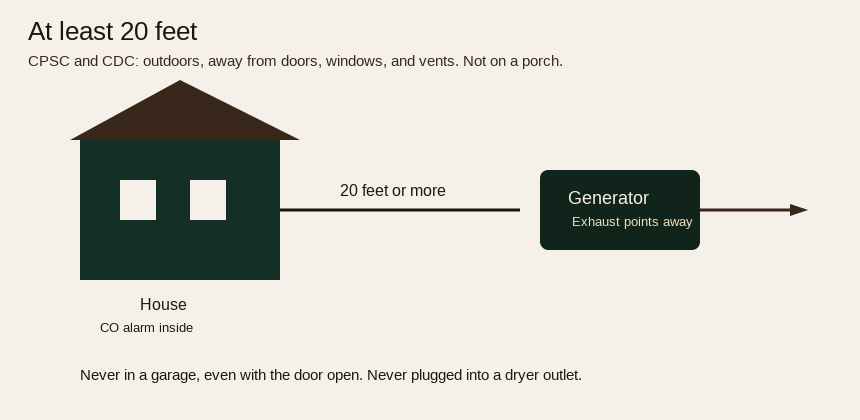
A generator stays outside, at least 20 feet from doors, windows, and vents. Never run one in a garage, even with the door open, and never plug it into a wall outlet. CPSC and the CDC both treat that distance as the minimum, because carbon monoxide is colorless and odorless.
A winter storm can drop lines for days. A wildfire shutoff can do the same on a dry, windy afternoon, on purpose, while the sky is still clear. Either way the question is the same: which loads have to stay on, and what can actually feed them. A battery, a solar array, and a generator answer different pieces of that question. None of them replaces the water, food, and light in a 72-hour kit.
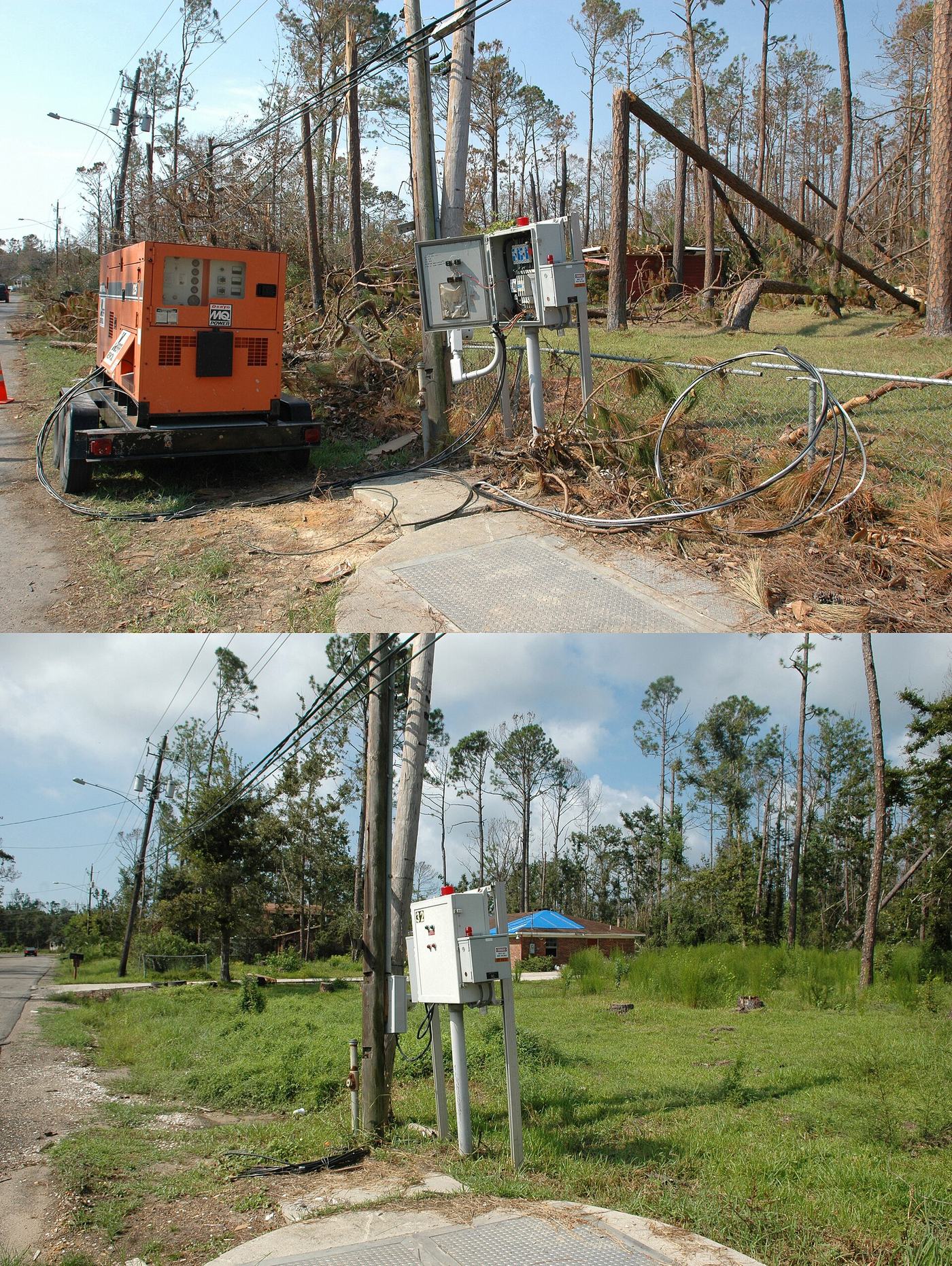
Ready.gov says to start by listing what in the house depends on electricity, including medical devices and whether the phone will work when the power is out. Do that list before you shop. The nameplate on each machine beats any chart.
Running watts, starting watts, and watt-hours
Running watts are what a device uses while it is already on. Starting watts are the brief extra pull when a motor starts. DTE Energy says motor-driven appliances such as refrigerators, freezers, and furnace blowers can need up to three times their running watts for that moment. A backup source has to cover the running total and the largest start, not just the quiet number.
Watt-hours are running watts multiplied by the hours the device is actually drawing power. A laptop that draws 200 watts for 5 hours uses 1,000 watt-hours. A refrigerator compressor cycles, so you cannot multiply its running watts by 24 and call that a day. The yellow EnergyGuide label, if the appliance has one, is the better daily budget. The chart below is not that label.
Honda’s generator sizing guide publishes approximate home wattages and marks several motors as needing 240 volts. Those figures are Honda’s, for planning, and Honda says not to add every start together if you can start the big motor first and then add the smaller loads. Read your own plates. A 120-volt power station cannot run a 240-volt well pump or a furnace fan that the plate says is 240 volts.
| Load in this example | Running watts | Starting watts | Honda note |
|---|---|---|---|
| Refrigerator or freezer, Energy Star | 132–192 | 1,200 | Approximate. Not marked 240 volts on Honda’s chart. |
| Gas or oil furnace fan, 1/3 horsepower | 700 | 1,400 | Honda marks furnace fans as 240 volts. |
| Sump pump, 1/3 horsepower | 800 | 1,300 | Honda marks this sump pump as 240 volts. |
| Laptop | 200–250 | 200–250 | Approximate. |
| A light bulb | The watts printed on the bulb | The same | Honda’s method. Five bulbs marked 10 watts are 50 watts. |
A worked pile, using the high end of Honda’s ranges and assuming the furnace fan is a 240-volt load you can actually feed: the fridge at 192 watts, the 1/3-horsepower fan at 700 watts running, a laptop at 250 watts, and 50 watts of bulbs. That is 1,192 running watts. If the fan is already running and the fridge then starts, the brief total is 700 plus 1,200 plus 250 plus 50, or 2,200 watts. If your fan or pump is 240 volts, a 120-volt station never gets to try that sum.
A well pump is a separate problem. Portland General Electric says well pumps often need 220 volts, some need only 110, and the starting surge can be up to six times the running watts. The Water Systems Council gives one example: a submersible often needs a generator of at least 3,500 watts, and a larger pump needs more. Use the pump label, and the notes in Well Water Without Electricity. Do not drop a guessed horsepower into this table.
Medical devices belong on the list with their own manuals. Ready.gov says to plan a backup for anything that keeps someone alive or refrigerated medicine cold. This page cannot size an oxygen concentrator from a generic chart.
The options
Portable power stations are batteries with inverters and outlets. Utah Emergency Management describes the solar versions as panels charging a battery you use later, and says to keep those batteries out of direct sun so they do not overheat. They are quiet and they do not make carbon monoxide. They run out. Recharge them from the wall before a storm, or from panels when the sky allows. Follow the maker’s manual for charging and storage. A station sized from the small tier below will not start a 240-volt well pump.
Home battery backup, with or without solar. The Department of Energy says most home solar systems have to be tied to the grid, so a dead grid shuts the solar off too. Batteries or a generator can bring that solar back. DOE calls batteries quiet and odorless, and says the outage runtime depends on the size you buy. It also says batteries can be costly, and that portable and backup generators are the less expensive options, with the tradeoffs of noise, smell, and carbon monoxide.
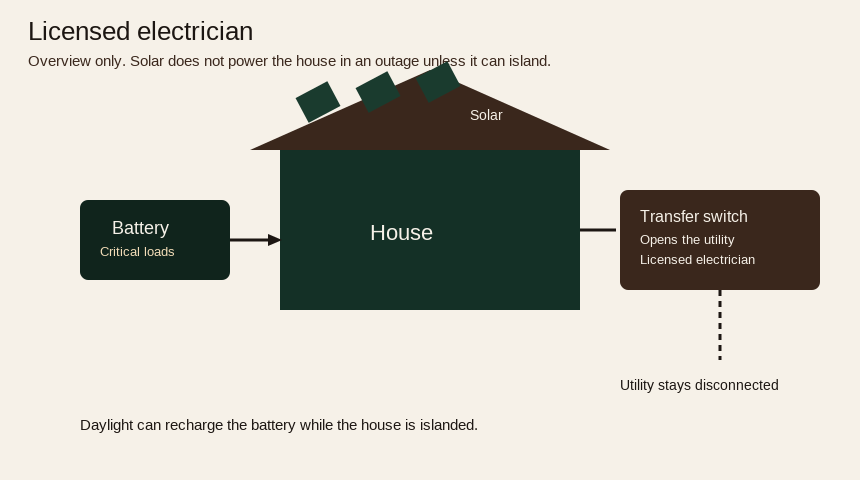
A DOE-hosted cooperative report explains the shutoff in plainer hardware terms. Inverters built to UL 1741 and IEEE 1547 are required to run only when grid voltage and frequency are stable, so ordinary panels go dark in an outage. With a battery, the inverter can switch and run isolated from the grid. The report calls that an intentional island: the unit disconnects, feeds a critical-loads panel, and, if solar is connected, the panels can recharge the battery while the sun is up. When the battery is empty, that backup stops. When the grid has been stable again, the system can reconnect. An electrician and the utility’s interconnection rules decide whether your array is allowed to do this. Panels alone, on a normal grid-tied inverter, do not.
Portable generators make electricity from an engine. They run as long as you have fuel and the engine holds. Utah Emergency Management says they are a short-outage tool, not a way to live for weeks, because they burn fuel and they break. Runtime is the fuel you stored, the load you put on, and how the machine is maintained. Turn it off when you are not using it.
Inverter generators are still engine generators. The difference shoppers care about is cleaner power for electronics and less noise. Confirm that on the model’s own manual. The safety rules below do not relax because the engine is quieter.
Dual-fuel and propane. A portable dual-fuel unit uses the fuel the manufacturer built it for, including a propane cylinder made for that generator. It is not a hose you invent off the house tank. A standby generator can be piped to the home tank by a licensed propane installer, with a transfer switch by a licensed electrician. That split is the subject of Home Propane When the Power Goes Out. PERC says those standby units typically draw from the home tank and sit outdoors.
Standby generators start on their own and feed selected circuits through a transfer switch. They are a whole-house project: gas line, electric permit, noise rules, and a service contract. PERC’s engine-fuel manual says only a person licensed for the electrical connection and the transfer switch should install one.
No public page used here publishes one price range that covers all of these. DOE says batteries can cost more than generators and does not print a dollar figure. Get quotes. Do not treat a national average from a shopping site as your bid.
See our top picks (coming soon) for portable power stations. No affiliate links yet.
See our top picks (coming soon) for portable and standby generators. No affiliate links yet.
A tiered plan
Small. Phones, a radio, and lights. Ready.gov tells you to have a flashlight for each person and a plan for batteries or a power bank. Honda’s chart puts a laptop around 200 to 250 watts and a radio around 50 to 200 watts. A bulb is whatever is printed on it. This tier is a charged power station or a bank of power banks. It will not keep food cold.
Medium. Add the refrigerator or freezer, and the furnace blower if you can feed its voltage. Use the worked sum above only as a sketch. Utah Emergency Management says to rotate loads if the source is small: run the fridge, then the freezer, and keep the doors shut. Ready.gov says a closed refrigerator holds about four hours and a full freezer about 48 hours. That is food safety, not a reason to skip a thermometer. The fridge rules we use are in the cold-storage note.
A gas furnace with no blower does not heat the ducts. If the fan is 240 volts, the medium tier needs a 240-volt source and a proper connection, not a 120-volt cord. Space heat from a gas oven is off the list. Ready.gov forbids it.
Whole home. A standby generator or a home battery with an islanding inverter, a critical-loads panel, and a transfer switch. Include the well pump only after an electrician reads the pump label. Include medical equipment on its own circuit plan. This tier is a permit and two trades, not a weekend cord.
Connect it safely
If the generator or battery feeds the house wiring, a licensed electrician installs a transfer switch or a listed interlock. OSHA says not to attach a generator to a building unless that transfer switch is in place. Without it, the machine can energize lines and put lineworkers and neighbors at risk. The Red Cross says the switch has to meet the National Electrical Code, which NFPA publishes, and state and local rules. CPSC’s name for the forbidden shortcut is backfeeding: plugging the generator into a wall outlet. A dryer outlet is that shortcut.
For a generator that only feeds cords, OSHA says to use the manufacturer’s cords or a grounded three-prong extension cord rated in watts or amps for the load. An underrated cord gets replaced with a heavier gauge. Heavier gauge means a lower American Wire Gauge number and a thicker wire. CPSC says the cord’s watt rating must be higher than the total of everything on that cord, the cord has to be outdoor-rated, long enough to keep the generator 20 feet out, and undamaged, with all three prongs. If a cord gets hot, it is overloaded or damaged. Do not run it under a rug or through a pinched window.
Fuel, stabilizers, and batteries
CPSC says not to store generator fuel in the house. Gasoline, propane, kerosene, and other flammable liquids go outside living areas, in labeled safety containers that are not glass, and not next to a fuel-burning appliance such as a gas water heater in a garage. Utah Emergency Management says to ask the local fire department how much you are allowed to keep, and to keep gasoline and propane in a shed or outbuilding, not in the house or an attached garage.
Refuel only when the engine is off and cool. CPSC says gasoline spilled on hot parts can ignite. Utah’s page says to wait about 20 minutes after the generator runs out before adding gasoline, and to wipe spills. Ready.gov says the same: let it cool, and keep the machine dry. Wet metal plus a generator is a shock.
If a gasoline generator will sit for more than a few months, Utah Emergency Management says to empty the tank or add a fuel stabilizer so the gasoline does not wreck the engine. Follow the stabilizer label and the generator manual. Have the oil the manual calls for.
Battery stations and home batteries have their own rules, printed by the manufacturer. Utah’s page says not to leave solar-generator batteries in direct sun. Charge and store them the way that manual says. Do not invent a workaround for a swollen or damaged pack.
If someone feels sick
Headache, dizziness, weakness, nausea, and confusion can be carbon monoxide, and they can look like the flu. CDC says people who are asleep can die before symptoms wake them. If anyone feels that way, or a CO alarm sounds, get outside and then call 911. CPSC says not to delay, and to test battery CO alarms every month. Put alarms on every level. A plug-in alarm with a dead battery is silent for the whole outage.
The National Weather Service winter page is where the forecast lives. Your utility is who announces a wildfire shutoff. Neither one will size the generator. The nameplate will.
Sources
- Ready.gov, power outages and winter weather.
- FEMA, “How to Prepare for a Winter Storm.”
- CPSC portable generator safety alert and CPSC winter weather tips.
- CDC, carbon monoxide basics.
- U.S. Department of Energy, “The Road to Resilience with Rooftop Solar.”
- U.S. Department of Energy and NRECA, “Energy Storage: The Benefits of Behind-the-Meter Storage”, on UL 1741, IEEE 1547, and islanding.
- Honda Power Equipment, generator wattage estimation guide. Approximate running and starting watts used in the example.
- DTE Energy, “Using a Generator Safely.” Starting surge up to three times running watts.
- Portland General Electric, powering wells during an outage, and the Water Systems Council power-failure sheet.
- OSHA Fact Sheet 3286 and OSHA, grounding portable generators.
- American Red Cross, generator safety, including the National Electrical Code published by NFPA.
- Utah Emergency Management, generator safety. Fuel storage, stabilizer, and battery care.
- PERC, residential propane guide and PERC engine-fuel manual.
- National Weather Service, winter safety.
Videos
Press play to load a video. Nothing from YouTube is requested until then.
Comments
Comments open soon. Nothing you type here is saved.