Home Propane When the Power Goes Out: What Still Works, and What to Leave Alone
If you smell gas, or a propane alarm sounds, get everyone outside. Do not flip switches, do not use a landline phone, and do not light anything on the way out. Call your propane supplier or 911 from outside, and stay away until they say the building is safe. The Propane Education & Research Council treats a suspected leak as a fire and explosion emergency.
A winter storm in the Mountain West can take the electric lines down and leave the propane tank sitting in the yard, still full. The gas does not need the grid. Many of the appliances on the end of that pipe do. This note is about telling those apart, keeping the tank itself safe in snow, and knowing which jobs belong to a licensed propane installer and a licensed electrician.
It is not a guide to cutting into a tank, a regulator, or a gas line. The Propane Education & Research Council says never to install, modify, or repair your propane system or appliances. Improper work can leak, and a leak can burn or explode.
Forecasts belong on the National Weather Service winter page. This note does not restate storm statistics.
What can keep running, and what stops
A standing pilot is a small flame that stays lit so it can light the main burner when you need it. PERC says to check the appliance manual to learn whether yours has one. A water heater, a cooktop, or a wall heater that lights from that pilot, with no blower and no electronic control board, can keep doing its job when the house lights are out. Some direct-vent and vent-free heaters use a millivolt valve: the pilot’s heat makes a tiny electrical signal that holds the gas valve, so the burner does not need house power. The data plate or the manual is the only way to know if a particular heater is built that way. A fan on that same heater will not spin until the electricity returns.
Other appliances stop even though the tank is full:
- A forced-air furnace uses an electric blower to move heat through the ducts. Without that motor, the furnace does not heat the house. Electronic ignition on the same furnace also waits for power.
- Many newer ranges light with a spark module instead of a pilot. If the knobs do nothing in the dark, do not take the stove apart. A match is only an option when the manufacturer’s lighting instructions say so, and only when you do not suspect a leak.
- Many tankless water heaters use a fan and an electronic board. Those go quiet with the grid. An older tank-style heater with a standing pilot may still heat water that is already in the pipes and the tank. It cannot refill itself if the well pump is also without power. That limit is covered in Well Water Without Electricity.
Ready.gov says not to heat the house with a gas stove or oven. Doing that raises the risk of carbon monoxide poisoning, and it can also start a fire, burn someone, or damage the appliance. A cooktop that you can light with a match is for cooking a meal, not for warming the rooms overnight.
If a pilot is out, PERC says to follow the manufacturer’s lighting instructions, and not to try if you suspect a leak. If the pilot is hard to light or will not stay lit, stop. Do not bleed air out of a gas line yourself. That releases gas. Call a qualified professional.
The tank, the gauge, and the shutoff
PERC says to ask the propane retailer for a visit so someone in the house can see what is under the dome: the shutoff, the regulator, and the safety relief valve, and how they are meant to work. The fuel gauge is on the tank. Check it through the fall. Talk with the retailer about delivery before a storm week, not when the gauge is already on empty. PERC does not publish a single “order at this percent” rule for every household. The retailer’s plan is the one that matches your tank and your winter use.
To close the service valve, PERC says turn it to the right, clockwise. Do that for an emergency plan you have practiced, or when a storm is about to flood the tank. PERC says if flooding is predicted, turn the gas off at the tank or cylinder before the water rises. Do not close the valve if you think the leak is at the tank itself. Get away instead.
If you do turn the gas off, or if the tank runs dry, do not turn it back on yourself. PERC says a qualified professional has to check the system for leaks before the gas is restored, and pilots have to be relit. You do not need to shut the tank off just because you are leaving town for a while. PERC says that is unnecessary.
Snow and ice are a Mountain West problem of their own. PERC says heavy snow and ice can damage piping, regulators, and meters and cause a leak, and that a blocked appliance vent can raise carbon monoxide in the house. Brush snow off with a broom, not a shovel, so you do not crack a fitting. Keep the regulator, the piping, the meter if you have one, and the tank area clear. Keep intake and exhaust vents clear, including roof vents. If a drift or a nest is more than you can brush away, call the retailer. Do not chip ice off a regulator with a tool.
A generator on the house tank
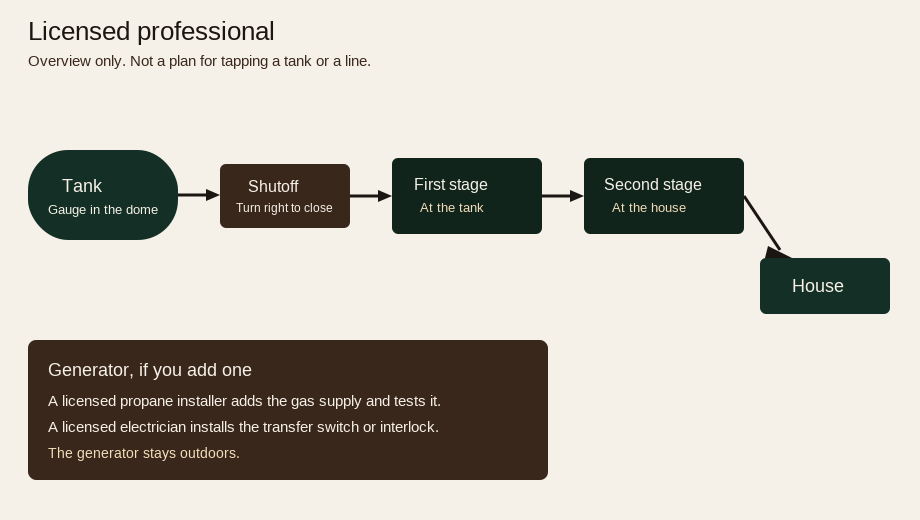
A propane generator can sit outdoors and draw from the same tank that feeds the house. PERC’s residential guide says standby units are placed outside, often beside a garage or a shed, and typically take propane from the home’s storage tank. PERC’s engine-fuel manual says a transfer switch disconnects the house from the utility before the generator feeds those circuits. Without that break, the generator can send power back onto the utility lines. The same manual says a propane generator should be installed only by someone licensed to make the electrical connection and to install the transfer switch, and that local permits and noise rules may apply.
Split the work the way the trades are licensed. A licensed propane technician connects the gas, on a supply the propane company sizes, and leak-tests it. A licensed electrician installs the transfer switch or a listed interlock so the utility breaker and the generator cannot feed the panel at the same time. OSHA’s portable-generator fact sheet says not to attach a generator to a building at all unless a qualified electrician has installed it with a transfer switch. The Red Cross points to the National Electrical Code for that switch. The CPSC says never to power the house by plugging a generator into a wall outlet. That includes a dryer outlet.
Portable dual-fuel generators that are not wired to the house are a different tool. Ready.gov says to run them outdoors, at least 20 feet from windows, doors, and attached garages, and to plug appliances in with outdoor-rated cords. They do not belong on a homemade tap off the house tank. If they use propane, they use the cylinder the generator was built for.
Can I run a line straight off the tank?
No. Not as a home project.
On a fixed home system, pressure is reduced in stages. A PERC-sponsored Battelle study of propane regulators describes the arrangement required for new domestic fixed piping since the 1995 edition of NFPA 58: a first-stage regulator at the container drops tank pressure to about 10 psig, and a second-stage regulator, usually at the house, drops that to about 11 inches of water column, the low pressure appliances are built for. One combination regulator can do both stages in a single body. The study says single-stage regulators are not for new fixed piping, because a failure could send container pressure toward the appliances. Those parts are matched, vented, and tested as a system. They are not a tee you add on a Saturday.
PERC says any change to the gas distribution system, including the tank, the pipes, and their components, is work for a qualified professional. So is installing or moving an appliance. The tank in the yard may be yours, or it may belong to the company that fills it. Ask before anyone touches it. Either way, a new outlet, a tee, or a generator supply is their job and, when they own the tank, it also needs their permission.
After the gas is turned on to a new line, or turned back on after a shutdown, the piping has to be checked for leaks. NFPA 54, the National Fuel Gas Code, says that check happens immediately, and if leakage shows up the supply stays off until the repair is done. The Texas Railroad Commission’s propane appliance guide points installers to that same rule. Pressure testing and leak testing are done to NFPA 54 and NFPA 58 and to the local code, with the instruments and the procedure those standards name. A homemade tap skips that test. It also leaves a fitting that can leak, and propane that escapes can ignite. Liquid propane on skin can freeze it. PERC warns that contact with leaking propane can cause frostbite.
Use outdoor appliances on the cylinders they came with. A 20-pound cylinder for a grill or a camp stove is not a substitute for a house-tank tap. Keep that cylinder outdoors, connected the way its manual shows.
Carbon monoxide
Propane that burns in the wrong place makes carbon monoxide. The gas is colorless and odorless. The smell you are told to notice is the odorant in unburned propane, not the CO in the exhaust. A propane detector does not replace a CO alarm. PERC says they are different devices, even when a combination unit exists.
CPSC’s winter guidance says never to run a portable generator inside a home, garage, basement, crawlspace, shed, or other enclosed space. Opening doors and windows is not enough ventilation. Run it outside only, at least 20 feet from the house, not on a porch or in a carport, with the exhaust pointed away from doors and windows. Close nearby openings. Look for a model with a CO shutoff. The CDC uses the same distance: more than 20 feet from windows, doors, and vents, and never in the garage even with the door open. Use a battery CO alarm, or one with battery backup, because a plug-in alarm with no battery goes silent in the outage. CPSC says to put alarms on each level and outside sleeping areas, and to test them monthly.
The CDC’s disaster guidance says generators, grills, camp stoves, and other gasoline, propane, natural gas, or charcoal devices should never be used inside a home, basement, garage, or camper, or outside near an open window. Ready.gov says the same about generators, camp stoves, and charcoal grills: outdoors, and at least 20 feet from windows. Do not bring a patio heater, a grill, or a construction heater into the kitchen to “just take the chill off.”
CO poisoning often feels like the flu without a fever: headache, dizziness, weakness, upset stomach, vomiting, chest pain, confusion. People who are asleep can die before they notice. If someone feels that way, or a CO alarm sounds, get outside and then call 911. PERC says to call 911 or the fire department once you are safely away, and not to go back in to air the house out first.
Clear snow from appliance vents so exhaust is not pushed back indoors. CPSC lists that with the winter tips. If you cannot clear a vent safely, leave it and call for service.
If you suspect a leak
PERC adds an odor to propane so a leak can be smelled. Ask the retailer to show everyone in the house what it smells like if anyone is unsure. A bad smell you cannot place is a reason to act. So is a hiss, a propane alarm, or gas use that jumped for no reason you can explain. On a cylinder, PERC also lists a visible cloud or flame at the cylinder as a leak sign.
You may not smell a real leak. PERC lists why: propane is heavier than air and can pool low, where no one is breathing; a cold, allergies, alcohol, sleep, or odor fatigue can dull the nose; other smells can cover it; and soil, water, or rust can absorb the odorant. Do not talk yourself into staying because the smell faded.
Leave. Do not operate light switches. Do not touch appliances, outlets, or a landline phone. No smoking, vaping, or flame. From outside, call the propane retailer, 911, or the fire department. Stay away until a qualified person says it is safe. Close the tank valve, turning it clockwise, only if you can do that without going near a leak at the tank. Afterward, the retailer or another qualified professional checks the whole system before any appliance is used again.
If a storm moves the tank, bends a line, or breaks a fitting, treat that as the same emergency. PERC says not to enter an area where you suspect a leak, and to use a flashlight rather than a candle when you have to look at storm damage in the dark.
Before the next storm
Post the supplier’s number and 911 next to the plan for shutting off propane, power, and water. PERC’s winter-storm page asks households to do that, and to have a technician inspect the system before the gas is turned back on if you shut it off. Install a UL-listed propane gas detector, following its instructions, and battery CO alarms on every level. Charge a phone, and keep a battery radio. Ready.gov also says to keep refrigerators and freezers closed. The food rules for a dark fridge are in Cold storage: keeping food safe when the power goes out.
Have the retailer show you the gauge and the shutoff while the weather is still ordinary. Fill the tank on their schedule. Brush the regulator before the drift buries it. And leave the piping alone.
Sources
- Propane Education & Research Council, safety guide for propane users. Leak response, odor, shutoff, snow, pilots, and the rule against homeowner repairs.
- PERC, propane safety and winter storms.
- PERC and Battelle, “Performance, Durability, and Service Life of Low Pressure Propane Vapor Regulators”. Two-stage regulation and the 1995 NFPA 58 practice described there.
- PERC, residential build-with-propane guide, on standby generators supplied from the home tank.
- PERC, off-road propane engine fuel, on transfer switches and who may install a propane generator.
- NFPA 54, National Fuel Gas Code, leak check after gas is restored. The Texas Railroad Commission propane appliance guide points to the same section.
- CPSC, winter weather tips on generators and carbon monoxide, and the portable generator safety alert.
- CDC, carbon monoxide poisoning basics, and clinical guidance after disasters.
- Ready.gov, power outages, and winter weather.
- OSHA Fact Sheet 3286, portable generators.
- American Red Cross, generator safety.
- National Weather Service, winter safety.
Videos
Press play to load a video. Nothing from YouTube is requested until then.
Comments
Comments open soon. Nothing you type here is saved.