Food Prep & Storage / Gardening
A preparedness garden for a short Idaho season
Updated 2026-11-23.
University of Idaho Extension’s planning bulletin (BUL 775) does not publish calories per square foot. It does say a small garden that is tended beats a large one that is neglected, and that a garden about 30 by 30 feet is enough for a family of four if you are not also counting on canning, freezing, or drying. If you are putting food up, the bulletin says plant larger. This page will not invent a calorie table to fill that gap.
A preparedness garden, for this site, means crops you can eat for months after harvest: dry beans, potatoes, winter squash, carrots, beets, and onions. Those are the crops the underground storage note and the root-cellar section are written for. Salad greens are worth growing. They are not the winter calorie store.
A 4-by-8 bed
Thirty-two square feet will not feed four people through a winter. BUL 775’s family-size note is hundreds of square feet, not one bed. One bed is a place to learn the season and to grow a share of the roots and beans. The drawing splits it into crops that either store or follow each other.
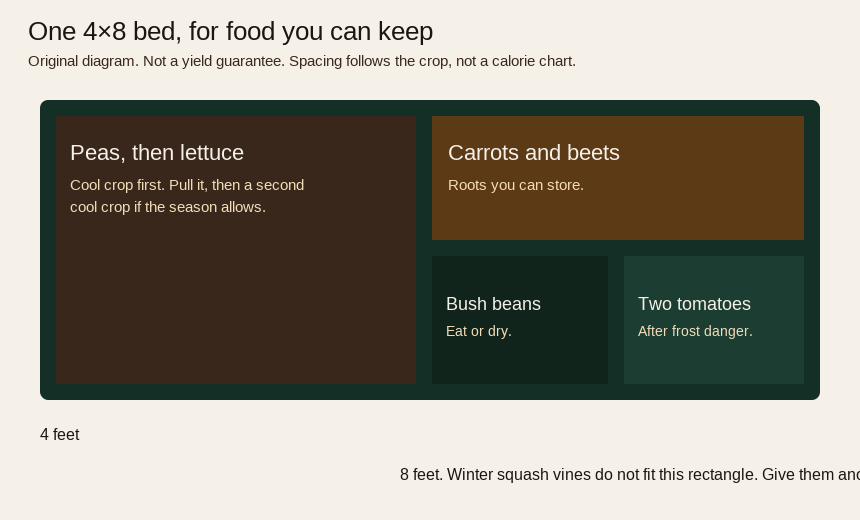
BUL 775’s spacing table, in inches between plants after thinning, is the one to use: carrots about 1 to 3, bush snap beans about 3 to 4, tomatoes about 36 to 60. Two tomato plants are enough for this rectangle. A winter squash vine is a second bed.
The Treasure Valley season is short. BUL 965 tells you to look up your USDA hardiness zone by ZIP at the USDA map and then use that column. Andy West, the Extension educator who wrote the guide, told Boise State Public Radio that Boise’s zone stayed 7a on the 2023 map, while some ground west of Caldwell and from Kuna toward Mountain Home shifted warmer. Enter your own ZIP. The bulletin says the printed dates can be off by one to three weeks in a pocket of different weather.
Hardiness is not the same as frost-free days. BUL 965 says the zone does not tell you how long the season is, and it points you to a frost-date lookup for your town. Do that before you treat any calendar on this site as the day you plant.
One-bed plan
Videos
Press play to load a video. Nothing from YouTube is requested until then.