Wildfire, smoke, and defensible space
Updated 2026-11-23.
When to leave, how to treat smoke, and what to ask your fire district before you cut a tree.
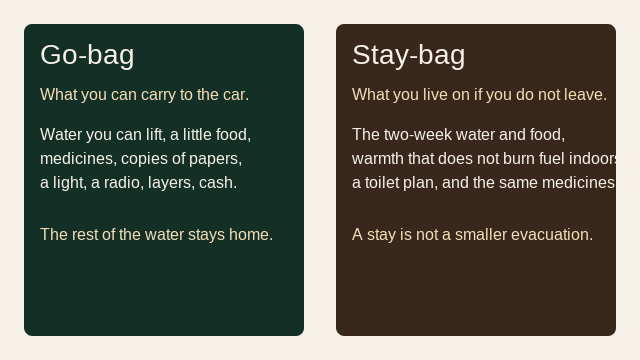
Leave when the notice says leave
Ready.gov’s wildfire guidance is to leave early when officials say to evacuate. Do not wait for a flame you can see. Foothill roads clog, and a late start is how families meet the fire on a two-lane road. Put the go-bag where you can pick it up in the dark. Tell the out-of-area contact which way you are driving.
If you are told to shelter, that is a different order from evacuation. Shut windows and doors, and do not run a swamp cooler or a fan that pulls outside air in while the smoke is thick. A stay is not safer than a leave if the leave has already been ordered.
Smoke and air
Wildfire smoke is an air-quality problem even when the fire is in another county. Check AirNow for the current air quality index instead of guessing from the color of the sky. On a bad day, stay inside, keep windows closed, and skip the outdoor errands. An N95 or a respirator that seals is what public-health pages describe for people who must go out. A cloth mask is not that.
Do not run a generator, a grill, or a camp stove in the garage because the house is smoky. Carbon monoxide does not care why you closed the windows. The staying-warm page has the CDC rule.
The ground around the house
Defensible space is the work of keeping the house from being the thing that burns. Distances and plant lists change with the fire district and the slope. This page does not print a ring of feet and pretend it is your lot. Ask the district, or Idaho Firewise, what they want cleared, limbed, and stored away from the wall this year.
The jobs that are almost never wrong: move the woodpile off the house, clean gutters of needles, and do not store gasoline against the siding. Do that on a calm day. A chainsaw in the wind of an approaching fire is not the project.
Checklist
Videos
Press play to load a video. Nothing from YouTube is requested until then.