Best hunting guns by game, and ammo you can actually find
23 November 2026. Compared from maker pages, not hunted with, and not tested by this site.
Affiliate disclosure: the price buttons are placeholders. Firearms are not sold through Amazon. When a real link replaces a placeholder, it will go to the manufacturer or a licensed dealer.
This is a first map for a family in the Mountain West that is new to hunting, or coming back after years away. It is organized by the animal, not by a brand. Seasons, tags, and legal weapons change every year. Read the current Idaho Fish and Game rules before you buy a tag or a box of shells. A neighboring state has its own proclamation.
Learn the rules before the gun
Idaho Fish and Game says hunter education is required to buy an Idaho hunting license if you were born on or after 1 January 1975, unless you can show a hunting license you already held, or a hunter-education certificate from Idaho or another state. Idaho Code 36-411 says a license shall not be issued to a person born after 1 January 1975 without that prior license or certificate. The statute’s “after” and the department page’s “on or after” are one day apart. Follow the department’s current page, and read the statute yourself.
The department’s Hunting Passport is a one-year way for a first-time hunter, age 8 or older, to hunt with a mentor before finishing the course. Someone who has already held a hunting license in any state is not eligible. The mentor must be 18 or older, hold an Idaho hunting license, and may not accompany more than two mentored hunters at once. Big game and sandhill crane start at age 10 for a passport holder. The page listed the passport at $1.75. The education page listed an instructor-led course at $9.75 and online courses at $38. Those prices were on the pages read 23 November 2026. Check them again before you pay.
Four handling rules, and a locked cabinet
Hunter-education courses teach a short set of handling rules. The NRA states three “always” rules and then adds knowing the target and what is beyond it. NSSF’s Project ChildSafe hunt tips use the same ideas in the field. In this site’s words:
- Keep the muzzle pointed in a safe direction the whole time the gun is in your hands.
- Keep your finger outside the trigger guard until you have decided to fire.
- Keep the gun unloaded until you are ready to use it, and still handle it as if it were loaded.
- Know what animal you are looking at, and what is behind it, before you shoot.
A mechanical safety is not one of those rules. Project ChildSafe says the safety can fail, so the finger stays off the trigger anyway. Unload before you climb into a stand, cross a fence, or put the gun in a vehicle.
Around children, hiding a gun in a closet is not storage. NSSF’s storage note for hunters says to store firearms unloaded, in a locked safe, cabinet, vault, or case, with a locking device as an extra layer, and to store ammunition in a separate locked place. When you come home, that is part of the end of the hunt, not a chore for later. This page does not explain how to alter a gun, a trigger, or a lock.
Why these cartridges
The cartridges below are ordinary commercial chamberings. Ammunition companies load them as regular hunting lines, and chain sporting-goods stores file them under those names. That is why a new hunter can usually find a box without a special order. This page does not claim a shelf count, a price at a store, or that a particular shop has stock today. A wildcat or a brand-new proprietary cartridge is the one you wait on. If the barrel is stamped for one cartridge, that is the cartridge you buy. .223 Remington, 5.56, 7mm-08, 7mm Remington Magnum, and 7mm PRC are different rounds. Do not mix them because the numbers look alike.
Upland birds and waterfowl
A 12-gauge or a 20-gauge pump shotgun covers pheasant, grouse, and ducks for most beginners. The 12-gauge is the shell you see most often. The 20-gauge is a bit lighter.
Mossberg’s 500 Hunting All Purpose Field, SKU 56420, is a 12-gauge pump with a 3-inch chamber, a 28-inch vent-rib barrel, Accu-Set chokes, a synthetic stock, and a listed weight of 7.5 pounds. The page listed it at $545. The 20-gauge version, SKU 56436, has a 26-inch barrel, the same 3-inch chamber, and a listed weight of 7 pounds, also at $545 on that page.
Check 12-gauge price Check 20-gauge price
Waterfowl are a different shell. The U.S. Fish and Wildlife Service says the nationwide ban on lead shot for waterfowl was in place by 1991. The legal list is in 50 CFR 20.21(j). Iron, which hunters call steel, is on that list. So are several bismuth and tungsten mixes. Lead is not. The rule covers ducks, geese, swans, and coots, and other birds in an aggregate bag during those seasons, in nontoxic-shot zones. Steel is the common choice because it is the ordinary nontoxic load on a store shelf, not because it is the only legal one. Upland birds on private land are not automatically under that federal rule. Idaho’s current proclamation can still require nontoxic shot on some ground. Read it.
Pattern the shotgun with the shells you will hunt with, at the distance you actually shoot. If a bird could fly through a hole in the pattern, that distance is too far for you. That is a check you do on paper, not a pellet count invented here.
Small game and varmints

.22 Long Rifle is the small-game cartridge for a reason: it is a standard rimfire that stores already know how to stock, and the rifles are light. Ruger’s 10/22 Standard, model 32006, is chambered in .22 LR, with an 18.50-inch barrel, a 10-round magazine, a listed weight of 4.2 pounds, and a suggested retail of $369 on that sheet.
.17 HMR is a step up in speed for prairie dogs and similar small targets, and it is still a catalog rimfire rather than a special order. Ruger’s American Rimfire overview says the .17 HMR models use a 9-round JMX-1 rotary magazine. This page does not print a barrel length or a weight for a .17 HMR rifle, because those numbers belong on the individual spec sheet and were not copied from a guess.
Predators and coyotes
.223 Remington is the common coyote chambering because loaded ammunition is a regular rifle cartridge, not a boutique order. Ruger’s Generation II standard list, read 23 November 2026, includes model 46909 in .223 Rem: a 20-inch spiral-fluted barrel, a 10-round AR-style magazine, and a suggested retail of $769. The barrel stamp is .223 Remington. Buy ammunition that matches that stamp. This page does not treat 5.56 as the same cartridge.
Deer and antelope
.243 Winchester, 6.5 Creedmoor, .308 Winchester, and .270 Winchester are the usual deer and pronghorn chamberings in this region because all four are ordinary centerfire hunting loads. On the same Ruger Generation II list:
- 46904, .243 Win, 20-inch barrel, 3-round AI-style magazine, suggested retail $769.
- 46901, 6.5 Creedmoor, 20-inch barrel, 3-round magazine, listed weight 6.5 pounds, suggested retail $769.
- 46902, .308 Win, 20-inch barrel, 3-round magazine, listed weight 6.4 pounds, suggested retail $769.
- 46914, .270 Win, 20-inch barrel, 4-round flush-fit magazine, listed weight 6.5 pounds, suggested retail $769.
Those rifles come from the factory with a scope base and no sights. A scope is a separate purchase. The sheets also list a muzzle device. This page does not tell you to change it.
Idaho’s hunter-education page on where to shoot says the effective shot on a large animal is into the heart and lungs, in the chest behind the front shoulder, and that you wait if you do not have a clear shot at those organs. Idaho Fish and Game says ethical hunters know their own limit: sight in from about 25 yards until you are on the paper, then at 100 yards or more, and practice from field positions, not only from a bench. Those distances are practice steps the department described. They are not a promise that 100 yards is your hunting shot. If you have not made that shot, from the position you will actually use, you do not take it.
Elk and bear
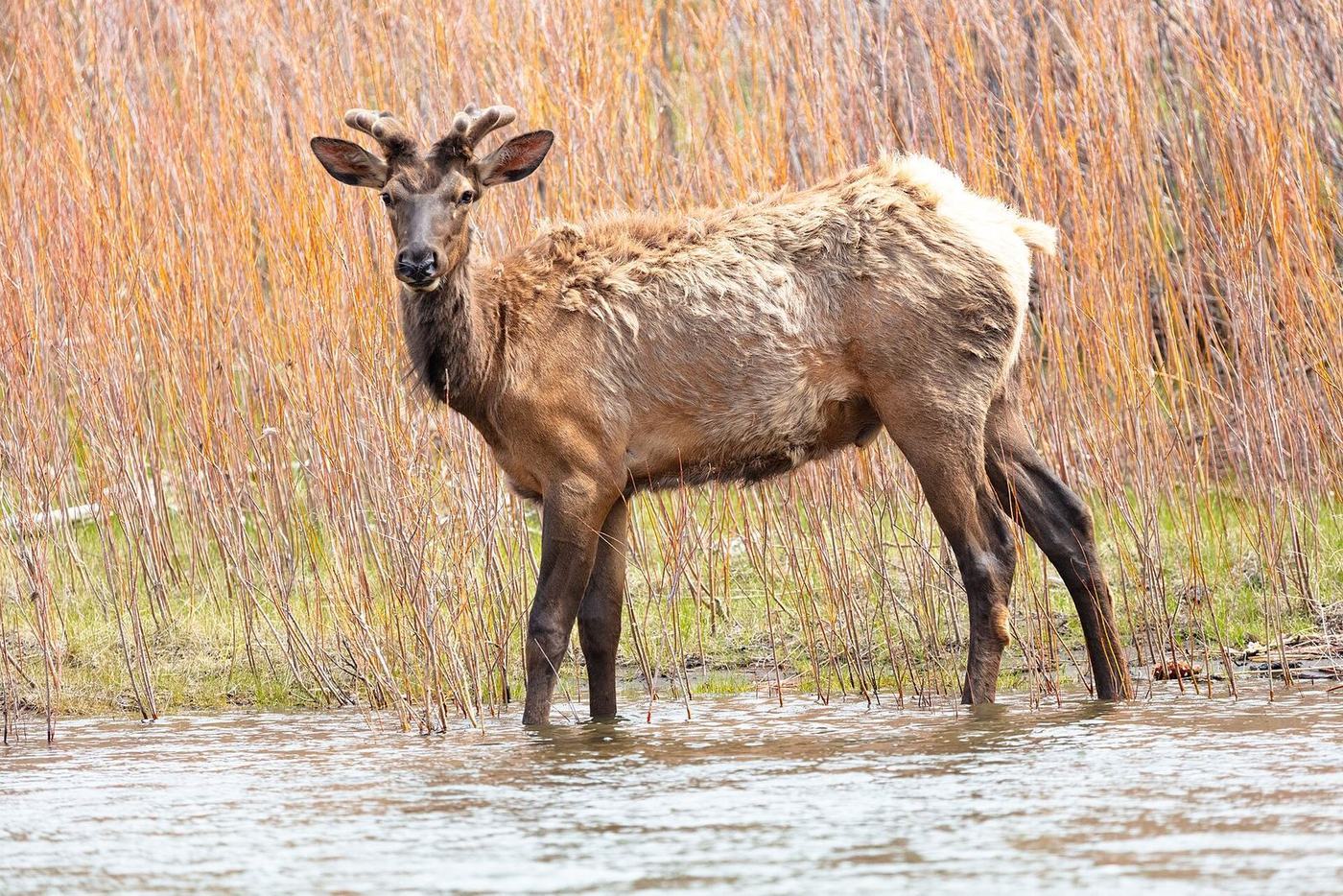
.30-06 Springfield, .300 Winchester Magnum, and 7mm Remington Magnum are the cartridges people in this country already associate with elk, and all three are loaded as standard big-game ammunition. Verified rifles from the pages opened for this note:
- 46913, .30-06 Springfield, 20-inch barrel, 4-round magazine, listed weight 6.4 pounds, suggested retail $769.
- 46915, .300 Win Mag, 20-inch barrel, 3-round magazine, listed weight 6.4 pounds, suggested retail $769.
Ruger’s Generation II standard list, as read that day, also showed a 7mm PRC (46917) and a 7mm-08 (46903). It did not show a 7mm Remington Magnum model on the portion of the list used here, so this page does not invent one. 7mm Remington Magnum remains a common elk cartridge you can ask a dealer to show you. Confirm the stamp on the barrel before you buy ammunition. It is not 7mm-08 and it is not 7mm PRC.
The same Idaho shot-placement page applies to elk: heart and lungs, a clear angle, and no shot through brush. A heavier cartridge does not fix a shot you have not practiced. Bear seasons and legal weapons are in the proclamation, not in a caliber chart.
One gun that does most of it
This is an opinion, not a rule from Fish and Game. If the household will own one centerfire rifle, the .30-06 on the 46913 sheet is the straightforward choice. Deer and pronghorn are inside what that cartridge is commonly used for, and elk is inside it when the shot is one you have already made on paper. The ammunition is a normal catalog item, which is the point of this list. A .308 or a 6.5 Creedmoor can be that one gun instead, for the same reason. A .300 Winchester Magnum is more gun than a new hunter needs for deer, and the practice to shoot it well is part of the decision.
The shotgun stays a second gun if you also hunt birds. A .30-06 does not replace a 12-gauge, and a 12-gauge does not replace a deer rifle.
Before you go
- Finish hunter education, or confirm that the passport and a mentor fit your case.
- Buy the tag the current proclamation requires. A gun does not come with a season.
- Match the ammunition to the stamp on the barrel.
- For ducks and geese, leave the lead shells at home.
- Practice from the positions you will use, and pass on any shot outside that practice.
- Come home, unload, and lock the gun and the ammunition up separately.
Household kits, cash, and a plan for when the phones fail are separate jobs: the 72-hour kit, if the internet goes down, and if communications go down. Tell someone where you are hunting and when you will be back. That is on Project ChildSafe’s hunt list, and it is the same habit as the family plan.
Videos
Press play to load a video. Nothing from YouTube is requested until then.
Resources
- Idaho Fish and Game — hunter education
- Idaho Fish and Game — Hunting Passport
- Idaho Code 36-411 — hunter education certificate
- Idaho Fish and Game — hunting
- U.S. Fish and Wildlife Service — nontoxic shot for waterfowl
- 50 CFR 20.21 — illegal hunting methods, including shot type
- Idaho hunter education — where to shoot
- Idaho Fish and Game — practice before the season
- NRA gun safety rules
- NSSF Project ChildSafe — ten tips for a safe hunt
- NSSF Let’s Go Hunting — secure storage
- Ruger — American Rifle Generation II model list
- Mossberg — 500 All Purpose Field, 12 gauge